105131
Associate in Applied Science Degree
Credits required for graduation: 67.00
Program name will change to Medical Laboratory Technician effective 6/1/2012.
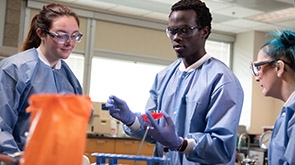
Clinical Laboratory Technicians collect blood specimens, culture and stain bacteria, make microscopic and chemical examinations of urine, blood and other body fluid and cross match blood. The role of a clinical laboratory technician is an important part of the detection, diagnosis and treatment of many diseases.
Students completing the program are eligible to take a national certification registry exam through the American Society for Clinical Pathologists (ASCP). Graduation is not contingent on passing the registry exam.
This program is accredited by the National Accrediting Agency for Clinical Laboratory Sciences, 5600 N. River Rd., Suite 720, Rosemont, IL 60018-5119, phone 773.714.8880.
Western's Medical Laboratory/Clinical Laboratory Technician Program ASCP Board of Certification Examination 5 Year Statistics
Students who graduate from an accredited Medical/Clinical Laboratory Technician Program are eligible to take the national American Society of for Clinical Pathology (ASCP) Board of Certification (BOC) examination. Certification by the ASCP BOC is required by most medical laboratory employers and serves as a symbol of commitment to the highest standards of the medical laboratory profession and quality in patient care. It has been found that certified laboratory professionals earn up to 14 percent more than non-certified counterparts and have greater career advancement and job mobility.
| Year
|
Western
1st time
Candidates
|
Number
Passing |
Western
1st time
Candidates |
National
Pass
Rate |
|
9 |
19 |
100% |
77% |
| 16
|
14 |
88%
|
73% |
| 7 |
7 |
100%
|
76% |
| 9 |
8 |
89%
|
76% |
| 10 |
10 |
100% |
77% |
Admission Requirements
Western accepts COMPASS, ASSET or ACT –Testing may be waived with applicable post-secondary credits. There is a $20 fee for this assessment (fee subject to change). If you have taken the ACT, ASSET or COMPASS within the last five years, you can request that your scores be submitted to Western. The testing requirements are:
| Assessment Area |
ACT |
ASSET |
COMPASS |
| English |
19 |
45 |
75 |
| Reading |
20 |
44 |
84 |
| Math/Numerical/Pre-Algebra |
19 |
44 |
58 |
The following requirements must be completed in order to qualify for acceptance to the Clinical Laboratory Technician program:
- Completed Criminal/Caregiver background check $20 (fee subject to change). The background check will be processed by Western (make check payable to Western). Western does not accept third party background checks (except in the case of out of state).
- Completed Immunization record, including TB
- Read program essential functions
- Completed American Heart Association Healthcare Provider CPR. Certification must be continually maintained throughout the program.
- Completed High School Chemistry, College Chemistry or Developmental Chemistry, and High School Biology or Developmental Biology with a C grade or better. (Prerequisite to General Anatomy and Physiology)
- Read online program overview.
- Completed Intent to enroll form.
Schedules
Clinical Laboratory Technician Follow-Up 2009-2010 Information
| Graduates | 15 |
| Graduates Responding | 10 |
| Employed In Related Occupations | 10 |
| Employed in Non-related Occupations | 0 |
| Seeking Employment | 0 |
| Continuing Education | 0 |
| Not In Labor Market | 0 |
Salary Data - Related Employment
| | Part(Time) | Full(Time) |
|---|
| Responding | 4 | 6 |
| Average Hours Per week | 26 | 40 |
| Median Hourly Wage | $17.05 | $17.18 |
| Hourly Wage Range | $11.57-$19.00 | $13.92-$19.97 |
| Median Annual Salary | $$23,173.80 | $34860.8 |
Respondents In Related Occupations
Lab Technician; Mile Bluff Medical Center, Mauston, WI
Lab Technician; Winona Health, Winona, MN
Medical Lab Technician; St. Elizabeth’s Hospital, Wabasha, MN
Medical Lab Technician; Richland Hospital, Richland Center, WI
Medical Lab Technician; University of Wisconsin, Middleton, WI
Medical Lab Technician; Mayo Clinic, Rochester, MN
Medical Lab Technician; Franciscan Skemp, Onalaska, WI
Medical Lab Technician; Moundview Memorial Hospital, Friendship, WI
Medical Lab Technician; Southwest Health Center, Platteville, WI
Phlebotomist; Franciscan Skemp, Onalaska, WI
Clinical Laboratory Technician
It takes hard work and dedication to become a clinical technician. It requires a strong background in such sciences as math, biology, and chemistry. A technician is expected to handle stressful conditions and to supply critical information for the patients' care.
It also takes a dedication to helping others and a desire to be recognized by other health professionals as a valuable member of the health care team. Clinical laboratory technicians may need to be able to work varied shifts (days, evenings, or nights) and may work some regular weekends and some holidays.
Student Success Guide.
Program Brochure
Program Head:
Carolyn Byom MS, MT(ASCP)
608.789.6284
byomc@westerntc.edu
Summer Contact:
Kathy Gregerson
Administrative Assistant
608.785.9233
GregersonK@westerntc.edu
Clubs
The CLT Club provides the opportunity for students to participate in Western College government activities, volunteer in community activities and learn more about the medical laboratory profession by attending the state Medical Laboratory Conference (ASCLS-WI) and
participating in a student quiz bowl, poster competitions and networking with practicing professionals.
Professional Organizations
Wisconsin Society of Clinical Laboratory Science (WISCLS)
American Society of Clinical Laboratory Science (ASCLS-WI)
Web Related Links:
Powerpoint Get a feel for what a day in the life of a CLT is like
Lab Science Careers
Labs Are Vital
American Society of Clinical Pathologists
American Society for Clinical Laboratory Science
National Accrediting Agency for Clinical Laboratory Sciences
Frequently Asked Questions
How Long is the Program at Western?
The Clinical Laboratory Technician Program at Western is 21 months long. The first year of the program will consist of fall and spring semesters and an eight-week summer session. The second year will include the fall and spring semesters with graduation at the end of May. Some students, however choose to spread the program out over three years taking science and general education courses for a year prior to formal entry into the program. This is a great help in reducing the workload of the program.
Will I be Required to Travel?
The program utilizes clinical sites In La Crosse, Onalaska, Tomah, Sparta, Black River Falls, Winona, and possible other locations during the first year. (A good running car and a valid driver's license or alternate transportation is required starting first semester for clinical.) During the second year, clinical sites are in La Crosse, Sparta, Black River Falls, Mauston, Hillsboro, Viroqua, Prairie du Chien, Tomah, Winona and Rochester to name a few. Students are responsible for their own transportation and housing, if they decide to stay at the outlying sites.
How much time will I spend in hospitals?
First year students attend clinical at area clinic and hospital labs for an enrichment experience for eight weeks in the fall and spring semester 3 - 4 hours per week. There is no clinical during the summer session. During the second year, students attend clinical full time the last 4 weeks of the fall semester and all of the spring semester at area hospital labs for a total of 20 weeks.
What happens after I graduate?
After graduation, students may seek employment as graduate clinical laboratory technicians. Graduates are then eligible to take a national registry exam given through a professional organization such as the American Society of Clinical Pathologists (ASCP), or National Certification Agency (NCA), etc. Upon satisfactory completion of this exam, the graduate is then certified by the ASCP, NCA, or etc. Students may have to take a licensure exam in some states in addition to being nationally certified.
Are there good jobs out there?
Clinical Laboratory Technician has been listed as a field anticipating severe shortages of qualified lab personnel. There is a good likelihood that the job market for technicians will remain strong for years to come. The Western Student Employment Services Office can provide job placement statistics for the previous year.
Essential Functions:
Essential functions have been identified for each program. These essential functions specify the physical, environmental, and cognitive/mental requirements that students may be expected to perform to complete the program. To obtain a detailed list of these functions, or inquire about accommodations for a documented disability, please contact Kristina Puent, Instructional Support Services at 608-785-9875, or PuentK@westerntc.edu . Students applying for admission to a program will be mailed a copy of the program's essential functions.