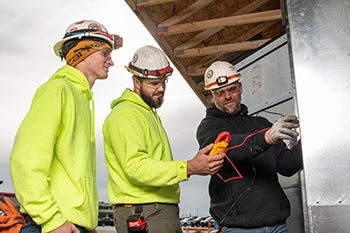
Apprenticeship is a post-secondary education, like a college or university. But there's a big difference. Apprentices learn only a portion of their skills in a traditional classroom. They receive most of their training on-the-job, while working for an employer who pays a good wage. Employment is the primary requirement for an apprenticeship—a job must exist in order for the apprentice to be trained. The classroom instruction is usually provided through the Wisconsin Technical College system.
Apprenticeships
How Do I Apply?
Select an Occupation
Explore what occupations and industry sectors fit your interests. You can search what industries are offered in your location and discover the average income offered. Wages may vary depending on the occupation you choose. Most apprentices begin at approximately 50% of the current skilled wage rate. Occupations may provide a periodic step increase every month or 1,040 hours. Apprentice’s wages must average 60% of the skilled wage rate during the term of the apprenticeship program.
Western’s apprenticeship programs offer opportunities in the construction, manufacturing, and education industries. Explore the options below.
Apply Directly to the Sponsor
Career seekers must apply directly to a sponsor. Application requirements will vary by occupation and sponsor. Construction registered apprenticeships are sponsored by local apprenticeship committees. All other registered apprenticeships are sponsored by individual employers.
Occupations & Career Paths
Select a career path to learn about the day-to-day job responsibilities and the coursework needed to learn and grow during your apprenticeship.
Construction Electrician
Future careers include jobs as estimators, distribution managers, inspectors, project managers, and foreman.
Early Childhood Education
Support the cognitive, social/emotional, and physical development of children through developmentally appropriate programming and environments.
Industrial Electrician
Maintain and repair electrical equipment like motors, transformers, generators, machine controls, and lighting systems.
Machinist/Tool & Die Maker
Analyze specifications, lay out metal stock, operate machine tools, and assemble parts or construct metal forms (dies) to shape metal in stamping and forging operations.
Maintenance Technician
Install, dismantle, or move machinery and heavy equipment and keep machines, mechanical equipment, or the structure of an establishment in repair.
Mechatronics Technician
Combine knowledge of mechanical systems, electronics, control systems, and computer technology to install, troubleshoot, and maintain complex automated equipment and robotics.
Plumbing
Install, repair, and maintain the water supply, waste water treatment, drainage, and gas systems in homes, commercial, and industrial buildings.
Student Resources and Funding Supports
Funding support may be available to help offset the costs associated with apprenticeship participation. These supports can vary depending on the program, location, employer, and individual circumstances, and may include assistance for tuition, basic needs, materials, or related training expenses. To learn more about what funding opportunities you or your organization might qualify for, please contact Sallie Braun for additional information and guidance.
Sallie Braun, Apprenticeship Outreach Specialist
Email: apprenticeship@westerntc.edu
Phone: 608-789-2079
Contact Us
For assistance or more information on apprenticeships, please contact: